Getting Oracle Fusion AI Agent licensing right in production is more urgent than most teams realize. The questions we’re hearing most from clients: Has the Agentic Applications platform fee already been triggered? Are our seeded agents actually free to run? And what do we do about governance while Oracle builds native controls? This post works through each of those decisions.
This is Part 2 of a two-part series. Part 1 covers how AI Units work, what action types cost, and what happens when you exhaust the monthly allocation. This post picks up from there with the licensing and governance decisions every delivery team needs to work through before 26C lands.
The Agentic Applications Platform Fee Is Already Active — 26C Doesn’t Change This
There’s a specific claim in circulation that billing “activates at 26C” — the upcoming July 2026 release. Here is what’s actually happening: the 26C milestone will bring consumption reporting dashboards, giving customers visibility into how many AUs they’re consuming and where. The AI Unit consumption itself — and the Agentic Applications platform fee — are already active in 26B production.
The trigger for the Agentic Applications platform fee is publishing an agentic application to a production environment. Not upgrading to 26C. Not enabling a feature flag. Publishing to production. Any customer who has deployed one of Oracle’s 22+ seeded Agentic Applications to their production Fusion environment, or who has published a custom application built in the Agentic Applications Builder, has already triggered the platform fee.
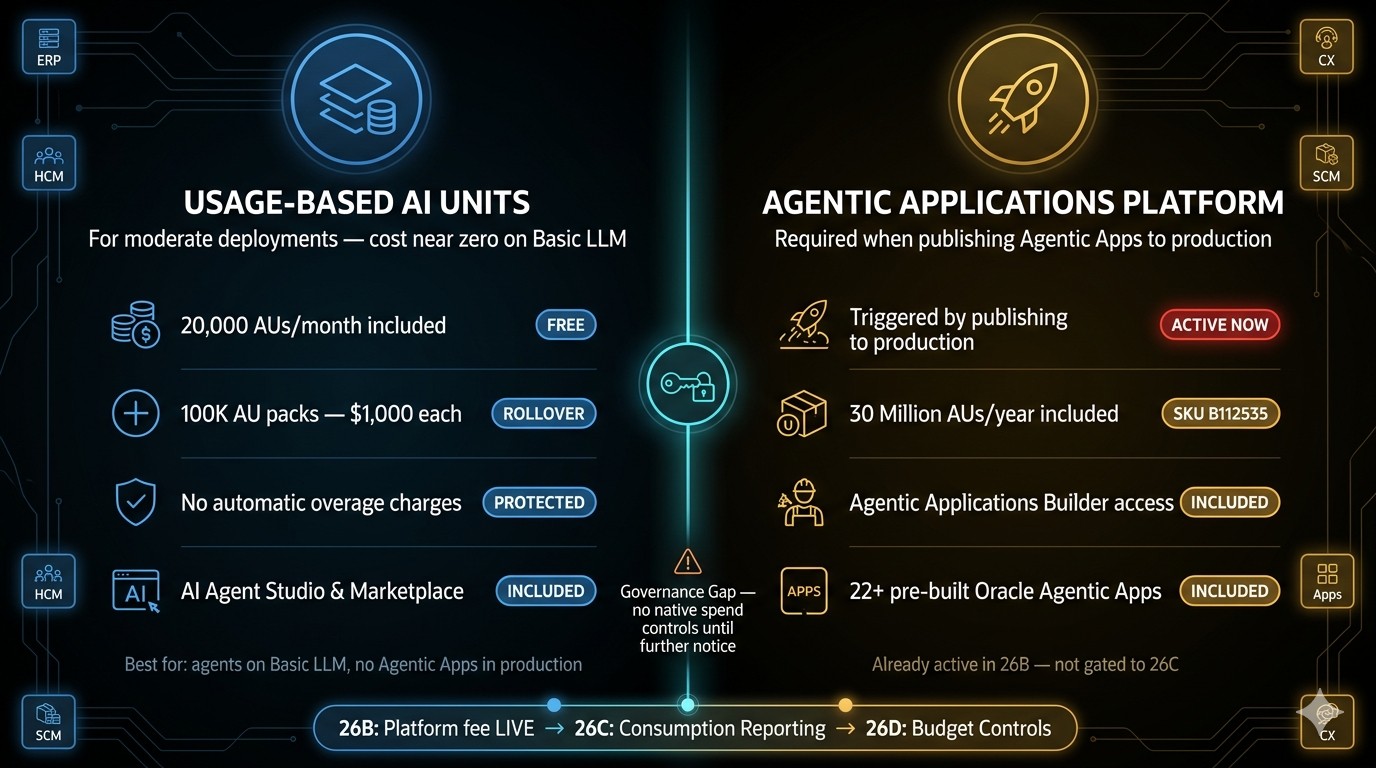
The platform fee SKU (B112535) provides 30 million AI Units per year on top of the base 20K monthly allocation, along with the right to publish agentic applications to production and access to the Agentic Applications Builder. Customers who took Oracle’s pre-built Agentic Apps in 26B — the Ledger Agent Command Center, Claims Settlement Workspace, and the others — need to confirm their Oracle contract includes B112535 if any of these are deployed to production.
For development and staging, the platform fee does not apply. You can build, iterate, and test agentic applications in non-production environments using your existing AI Unit allocation without triggering the platform SKU. The trigger is specifically the production publish action.
Even Seeded Agents Like Ledger Agent and Payables Agent Have a Cost Depending on How They’re Configured
A common assumption is that Oracle’s own pre-built agents — Ledger Agent, Payables Agent, Expenses Agent — run free because they’re seeded. This is not how the pricing model works. If any agent, including a seeded one, runs entirely on Basic LLM and performs no Document Generation, it is free. If it performs Document Generation or uses a Premium LLM, those actions are metered — regardless of who built the agent or where it came from.
Oracle notes specifically that agents doing complex reasoning, including the Ledger Agent by name, may use Premium LLM by default for certain workflows. The model choice underneath the agent is what determines cost. My Oracle Support has a document listing the deployed LLMs by agent type — consulting teams implementing Ledger Agent or Payables Agent should check that reference to understand whether their specific configuration is running on Basic or Premium, and what the AU consumption looks like at their client’s expected transaction volume.
Two Commercial Choices — And They Replace the Old Subscription Model Entirely
If you read our March 2026 post, you’ll remember Oracle’s pricing then was structured around Per Authorized User and Per Employee subscriptions, with a 200 million token monthly allocation for Oracle-hosted LLMs. Those SKUs are now being retired — non-renewable and non-expandable — and the AI Units model is what replaces them.
For most Fusion AI deployments, the commercial decision comes down to two choices:
Choice 1 — Usage-based AI Units. You consume from the 20K monthly allocation and buy additional 100K packs ($1,000 each, rollover) as needed. Right for organizations running agents at moderate volume, primarily on Basic LLM, without publishing full Agentic Applications to production. Cost can be very close to zero if workloads stay on General Actions with Basic LLM.
Choice 2 — Agentic Applications Platform SKU (B112535). For organizations deploying Oracle’s pre-built Agentic Applications or publishing custom apps to production. Provides 30 million AUs per year and the production deployment right, along with access to the Agentic Applications Builder. This is a significant commercial commitment that warrants a proper business case — but if you’re already live with Agentic Apps in 26B production, the conversation with your Oracle account team needs to happen now, not at 26C.
A usage estimator calculator is available from Oracle to model costs before committing — worth running through with any client in the pre-contract phase.
There Are Currently No Native Controls to Cap AI Unit Spending
This is the governance gap every Fusion AI project manager needs to understand going into 26C. There is no native budget cap, no alert threshold, no automatic shutoff at a dollar amount. The only way to stop AU consumption today is to unpublish agents. Budget and cap controls do not have a confirmed release date in Oracle’s current documentation.
What’s confirmed for 26C (arriving July 2026) is consumption reporting visibility. That’s meaningful — right now, customers have no dashboard showing how many AUs they’ve burned this month. When 26C lands, teams can see their consumption in near-real time. But seeing it and controlling it are different things.
The practical governance posture in the meantime: treat the monthly 20K allocation as your soft ceiling, purchase AU packs for anticipated production workloads, and run a manual monthly review of agent activity in the AI Agent Studio monitoring console.
What to Do Before Your Next Client Conversation on This Topic
First, identify which agents in your 26B production environment are running on Premium LLM and which are generating documents. These are your metered workloads. For seeded agents, check the MOS reference for deployed LLM configurations. For custom agents, check the LLM setting in AI Agent Studio directly.
Second, confirm whether any agentic applications have been published to production. If yes, verify that B112535 is in the Oracle contract. If it’s not, this is an urgent conversation with your Oracle account team — not a post-26C concern.
Third, do the math on your multi-pillar deployment. If you’re running agents across ERP, HCM, and SCM, add up the expected AU consumption across all of them against the single 20K monthly pool. If the aggregate exceeds 20K even occasionally, purchase AU packs now rather than waiting for 26C reporting to tell you after the fact.
Fourth, brief your project stakeholders on the absence of native budget controls. The controls are coming, but the consumption is already running. Until they arrive, your governance is manual — make sure someone owns that monthly review.
Oracle’s pricing model for Fusion AI is more favorable than the most alarming interpretations circulating right now. No automatic overage charges. Basic LLM General Actions always free. A meaningful monthly allocation included by default. But the Document Generation cost, the shared-pool reality for multi-pillar deployments, and the already-active Agentic Applications trigger are all places where assumptions fail and surprises happen. Get those three right and the rest of the model is straightforward.
Quick Reference: Oracle Fusion AI Pricing FAQ
| Question | Answer |
|---|---|
| Is AI Agent Studio included in my Fusion subscription? | Yes. AI Agent Studio and the AI Agent Marketplace are included at no additional cost in all Oracle Fusion Cloud subscriptions. |
| How many AI Units do I get for free each month? | 20,000 AUs/month — shared across all Fusion pillars (ERP, HCM, SCM, CX) and all environments (production + dev/test combined). Unused AUs expire at month end; they do not roll over. |
| How much is one AI Unit worth? | $0.01. A 100,000-AU pack costs $1,000. |
| What does a General Action (query, approval, reasoning) cost? | Basic LLM: free. Premium LLM: 5 AUs ($0.05). BYO LLM: 3 AUs ($0.03). |
| What does Document Generation (Word doc, slides, PDF) cost? | Basic LLM: 10 AUs ($0.10). Premium LLM: 20 AUs ($0.20). BYO LLM: 10 AUs ($0.10). Document Generation is not free on any LLM tier. |
| Is Basic LLM always free? | Only for General Actions. Document Generation on Basic LLM costs 10 AUs per document. |
| What happens if I run out of AI Units? | Basic LLM General Actions continue running — always free. Premium LLM actions and Document Generation stop until the pool resets or you purchase more AUs. No automatic billing for overages. |
| Will I get a surprise invoice if agents run over the limit? | No. Oracle Fusion SaaS does not support automatic billing for overages. Metered actions stop; they do not generate an unexpected charge. |
| Do dev/test environments consume the same AU pool as production? | Yes. Dev/test shares the same 20K monthly pool as production. Only the Agentic Applications platform fee is non-prod-exempt — it triggers only on publishing to production. |
| Does each Fusion pillar get its own 20K allocation? | No. One shared pool across all pillars and environments. Exception: multiple production environments each get their own 20K. |
| What is the Agentic Applications Platform SKU (B112535)? | A separate annual subscription: 30 million AUs/year plus the right to publish agentic apps to production and access to the Agentic Applications Builder. Required to deploy Oracle’s pre-built Agentic Apps to production. |
| When is the Agentic Applications platform fee triggered? | When you publish an agentic application to a production environment. Already active in Release 26B — not gated to 26C. |
| Is billing activating at 26C? | No. What arrives in early 26C is consumption reporting dashboards. AU consumption and the Agentic Apps platform fee are already active in 26B production. |
| Is Ledger Agent free to run? | Only if it runs entirely on Basic LLM with no Document Generation. Ledger Agent may use Premium LLM for complex reasoning workflows — those actions are metered. Check MOS for the deployed LLM configuration. |
| Are seeded agents priced differently from custom ones? | No. Cost is determined by model choice and action type — not by whether the agent is seeded, custom, or from the Marketplace. |
| Can I use my own LLM (Claude, Gemini, etc.)? | Yes. BYO rates: 3 AUs for General Actions, 10 AUs for Document Generation. You are responsible for your own BYO LLM support. |
| Does the Brain / prompt optimization feature in Studio cost AUs? | No. Design-time features in AI Agent Studio do not consume AI Units. |
| What SKUs should I look for in the Oracle contract? | B112536 (100K AU pack, rolls over), B112535 (Agentic Apps platform, 30M AUs/year), B112537 (Named User, 15K AUs/user/month), B112538 (Employee, 500 AUs/employee/month). Old SKU B111575 and the Per Authorized User / Per Employee SKUs from the earlier model are being retired — non-renewable and non-expandable. |
| Are there budget caps or spend limits I can set? | Not currently. The only way to stop AU consumption is to unpublish agents. Native controls have no confirmed release date. |
| Is there a usage estimator calculator? | Yes — ask your Oracle account team or check AI Agent Studio resources. |
| What are the Named User and Employee SKUs (B112537/B112538)? | These are in Oracle’s SKU list but carry a “reasonable use” cap — meaning Oracle can limit consumption within the subscription. Confirm current applicability with your Oracle account team before treating these as a mainstream deployment option. |
| Do purchased AI Unit packs roll over? | Yes. Purchased AU packs roll over until end of subscription term. The free 20K monthly allocation does not. |
| Can Oracle change the pricing? | Yes, with 30 days’ notice. |