
We’ve all been there—your message processing pipeline is cruising along, and suddenly one problematic message brings the system to a halt.
In a transactional system, when order matters for one business entity, all subsequent messages for that entity must not be processed, or you risk losing sequence and corrupting state.
A Death Letter Queue (DLQ) lets you move the failed message aside, keep the rest flowing, and reprocess later.
The Problem
Failed messages that auto-retry can:
- Block subsequent messages for the same key/transaction.
- Back up entire partitions at high volume.
- Burn compute on repeated, fruitless failures.
A Simple Design
- Detect a failure in the consumer.
- Persist the failed message and its metadata into the DLQ.
- Acknowledge the original message to the broker to continue processing.
Table Design
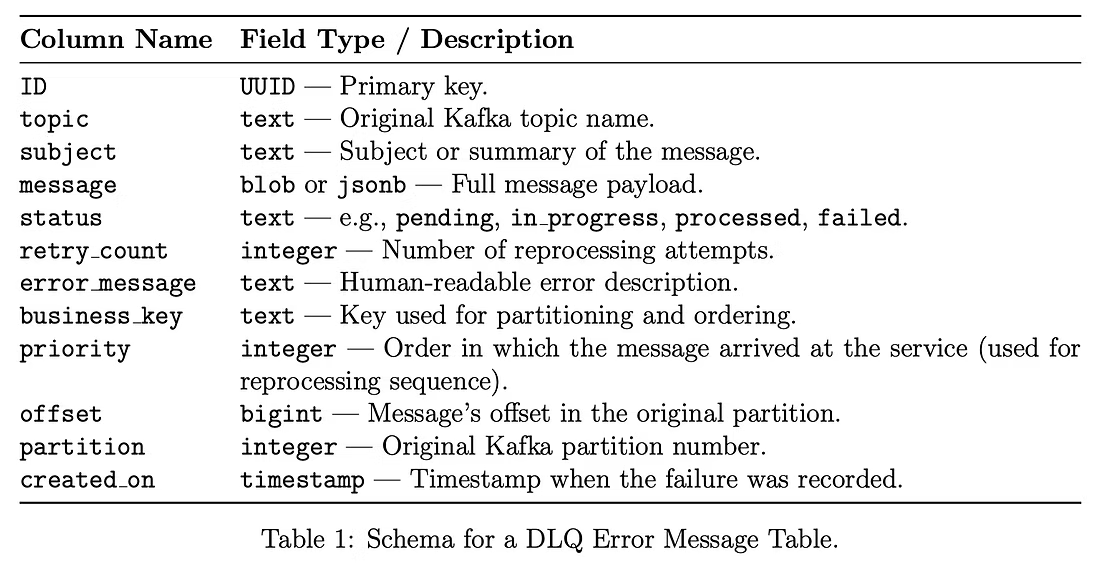
Error Message Table
Here is a sample schema for a DLQ table used to store failed messages.
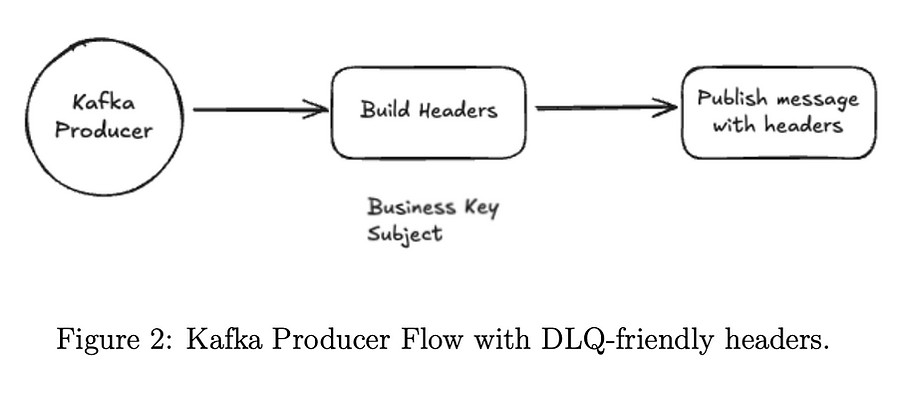
Kafka Producer
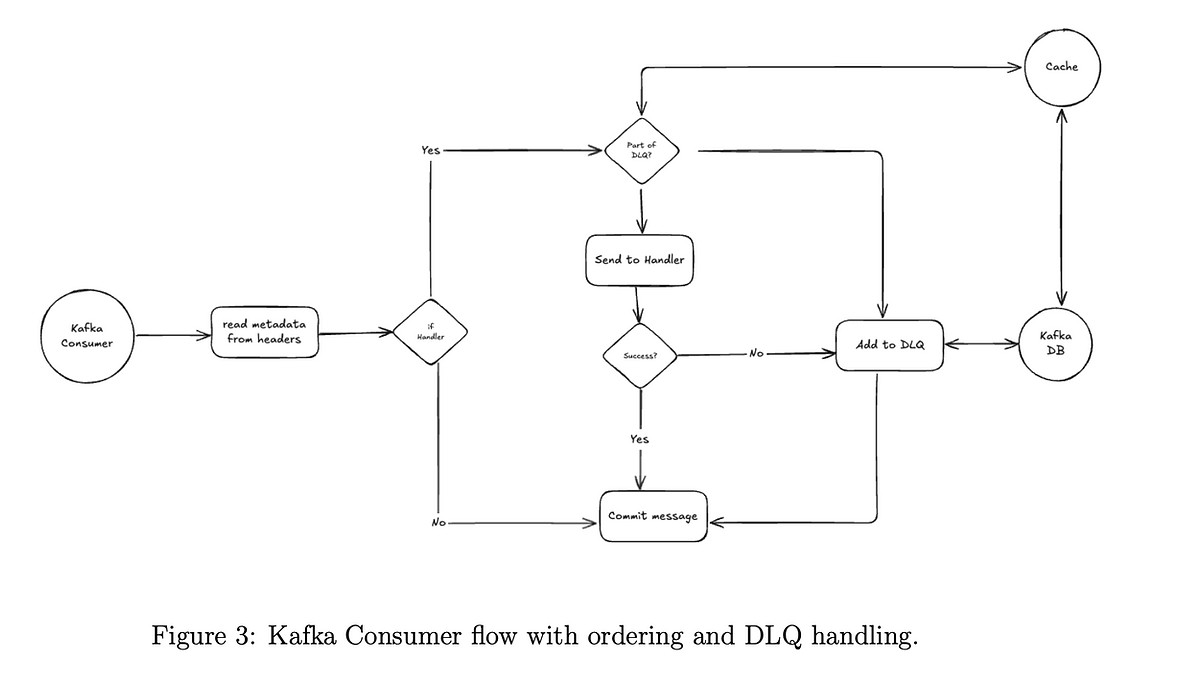
To facilitate efficient DLQ handling, add rich metadata to every message header.
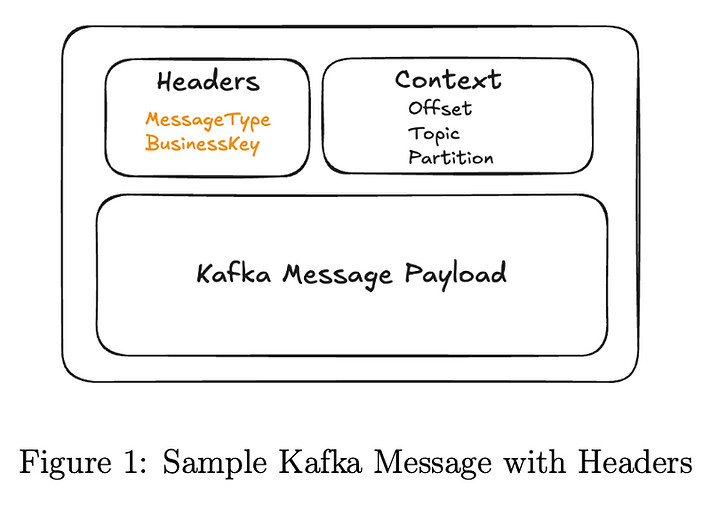
Business Key: Allows consumers and routing logic to identify the entity without deserializing the payload.
This is crucial for catching serialization issues early and checking for prior failures for the same key.
Message Type: Enables consumers to quickly filter messages.
If a topic contains multiple event types, a consumer can inspect the header and discard irrelevant messages without the overhead of deserialization.
Yes, this adds minor work for the producer, but it significantly reduces consumer overhead and accelerates failure handling.
Kafka Consumer
The consumer logic becomes more robust: before processing, it inspects headers and checks if any prior message with the same Business Key is already in the DLQ.
If so, it parks the current message in the DLQ to preserve order.
Trade-off: Each message now incurs a small overhead for the DLQ state check.
This path must be highly optimized in high-throughput systems, for example, by using a fast cache like Redis to track failed business keys.
DLQ Reprocessing
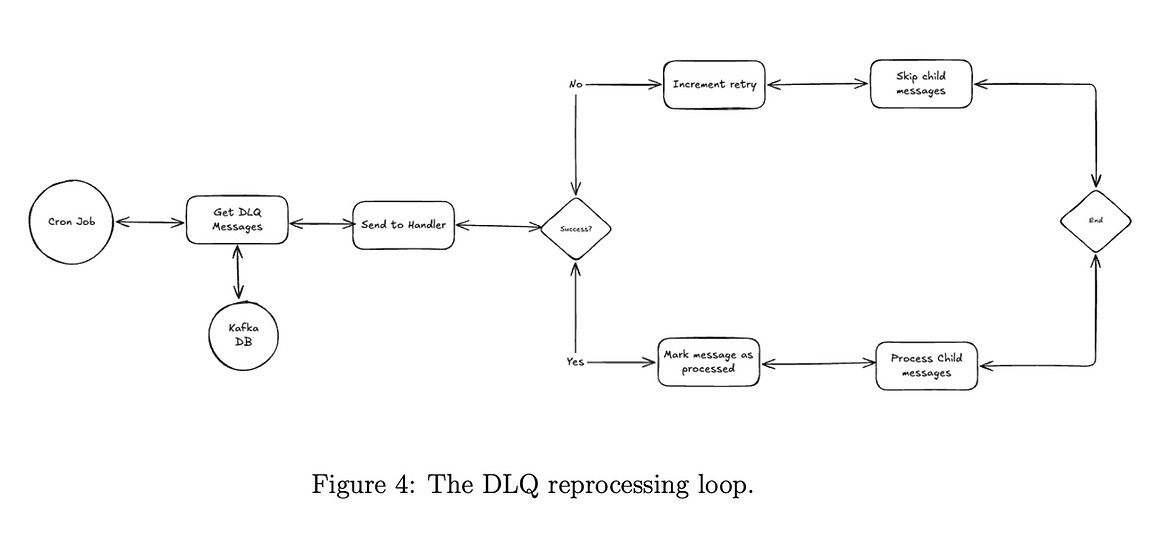
A scheduled job or manual trigger can initiate reprocessing from the DLQ.
- It pulls pending items from the DLQ, often based on priority or created on.
- It attempts to re-process them, ideally with updated application code or corrected data.
- It updates the message’s status in the DLQ to processed or increments the retry count and marks it as failed if it still fails.
Running in a Multi-Pod Environment
In production, multiple pods may be running.
Ensure only one pod performs DLQ reprocessing at a time by using a distributed lock in the existing Redis cache:
- Acquire a lock with an expiration:
SET dlq:reprocessor:lock <instance id> NX EX 300. - If acquisition fails, skip reprocessing on that pod.
- Renew the lock periodically while working; release it only if
<instance id>matches. - Keep reprocessing idempotent so retries are safe if a lock expires mid-run.
Operational note: There are usually not many messages in the DLQ, so the additional load on the single pod processing them is minimal, and it typically runs during off hours.
Pros & Cons
Pros
- Resilience: Keeps the main processing pipeline unblocked by faulty messages.
- Order Preservation: Guarantees transactional order for a given business key.
- Performance: Fast routing and filtering via headers such as businessKey and messageType avoids expensive deserialization of every message.
- Observability: Provides a clear, persistent record of failures for debugging and analysis.
Cons
- Complexity: Adds development effort for producer/consumer logic and regression testing.
- Overhead: Adds a per-message latency cost for checking in the Redis cache whether the businessKey is part of the DLQ. Since Redis lookups typically complete in under 1 ms, this overhead is negligible.
- Infrastructure: Requires an additional data store, the DLQ table, and a reprocessing mechanism.
- Reordering Logic: Re-injecting processed messages in the correct order can be complex if there are dependencies.
Final Thoughts
A DLQ is a safety net for your event-driven architecture.
It provides a robust pattern to handle inevitable failures gracefully.
It allows you to fail fast, park messages safely, and recover intentionally, all without compromising system throughput or data integrity.