
AWS Serverless Essentials: Services, Flow, and Use Cases
Businesses need systems that react instantly, scale automatically, and keep costs under control.
Serverless architecture does exactly that: it lets teams focus on business logic and customer experience while AWS handles infrastructure, scaling, and availability.
This post explains serverless basics, the AWS building blocks, and a concrete real-world example — a real-time order processing and notifications system.

Does Serverless Architecture Intrigue You?
Have you ever wondered…
- What exactly is serverless architecture?
- If there are no servers, where does my program run?
- Why are companies shifting toward it?
If these questions sound familiar, you’re in the right place.
Below we unpack the what, how, and why — then walk through a complete AWS-based example and design.
What is Serverless Architecture?
“Serverless” doesn’t mean there are no servers — it means you don’t manage them.
In serverless:
- you write and deploy code or configure managed services,
- the cloud provider (AWS) provisions, scales, and patches the infrastructure,
- you pay only for usage (no idle server costs).
Serverless is ideal for event-driven systems, APIs, data pipelines, and bursty workloads where automatic scaling and cost-efficiency are top priorities.
Use-Case
This use case models a high-traffic ecommerce event where orders must be processed immediately, payments confirmed, inventory updated, customers notified, and business analytics updated in real time.
The solution must handle sudden traffic spikes, ensure payment security and data integrity, and deliver near-real-time dashboards for operations and product teams.
High-level Flow
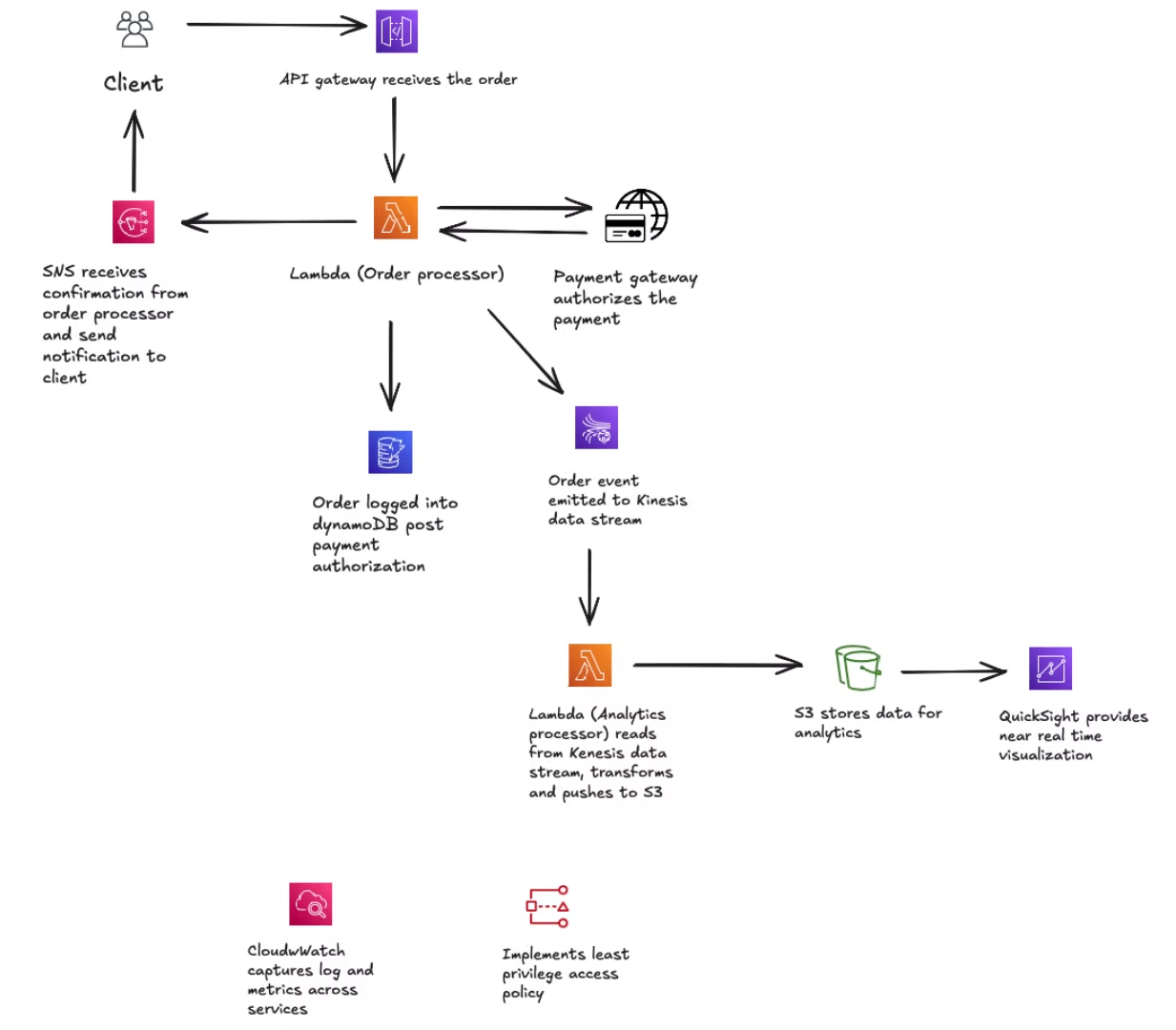
Step by Step
API Gateway – Acts as the secure entry point for customer order requests, managing authentication, throttling, and routing to backend functions.
Order Processor Lambda (AWS Lambda) – Runs serverless business logic, validating orders, checking DynamoDB inventory, and orchestrating payment authorization through the external payment API.
External Payment API – Handles secure, PCI-compliant payment processing, returning approval or rejection to the Order Processor Lambda.
DynamoDB – Stores and updates order and inventory data in milliseconds, ensuring real-time accuracy for subsequent steps in the flow.
SNS (Simple Notification Service) – Instantly pushes order confirmation messages (via email, SMS, or push notifications) to customers, triggered directly from the Order Processor Lambda once the payment succeeds.
Kinesis Data Streams – Captures live order events as they happen, streaming them to analytics pipelines for immediate insights and anomaly detection.
Analytics Processor Lambda (AWS Lambda) – Processes incoming streams from Kinesis, enriching data and storing the results in S3 for reporting.
S3 (Simple Storage Service) – Serves as the durable data lake, keeping historical analytics data and feeding it into QuickSight for visualization.
QuickSight – Delivers interactive dashboards and reports to stakeholders, powered by analytics data from S3.
CloudWatch – Monitors logs, metrics, and system health across all AWS services, sending alerts on performance issues or anomalies.
IAM (Identity and Access Management) – Governs secure, least-privilege access between services, ensuring every interaction is authenticated and authorized.
Why this Architecture Works
- Scales automatically during traffic spikes (e.g., product drops).
- Cost-efficient — you pay per execution/throughput, not for idle servers.
- Resilient & decoupled — Kinesis and SNS decouple order submission from downstream analytics and notifications.
- Observability & security are central (CloudWatch, KMS, IAM).
Security & Compliance Considerations
- Least-Privilege IAM Roles: Lambda functions have access only to the resources they need (fine-grained roles).
- API Security: JWTs, Cognito, or OAuth, plus WAF and throttling at API Gateway.
- Payment Compliance: Tokenization is used and the external payment provider handles PCI scope; card data are not logged.
- Encryption: SSE for S3, server-side encryption for DynamoDB, and KMS-managed keys.
- Secrets Management: API keys and credentials are stored in AWS Secrets Manager or Parameter Store (credentials are not written in code or environment variables in plaintext).
- Observability & Auditing: CloudWatch Logs, CloudTrail for API auditing, and X-Ray tracing for distributed tracing.
- Network Controls: VPC endpoints for private access to AWS services where required.
- DDoS Protection: AWS Shield / AWS WAF for public-facing APIs.
Deployment & Cost Considerations
- Prototype Cost: This architecture is extremely inexpensive at low volume (Free Tier covers many Lambda and API Gateway requests) — near-zero cost for small testing volumes.
- Production Scaling: Monitor Lambda concurrency and Kinesis shard counts; use appropriate on-demand vs provisioned capacity for DynamoDB to balance performance vs cost.
- CI/CD: Use CloudFormation/CDK or CodePipeline for repeatable deployments and infrastructure-as-code.
Conclusion
This serverless design provides a robust, scalable, and cost-effective approach to real-time order processing and analytics.
It decouples transactional flows from analytics, ensures secure payment processing, and delivers near-real-time insights for business teams — all while removing the burden of server management.